// Portfolio05 UI/UX Design
CYBERBID
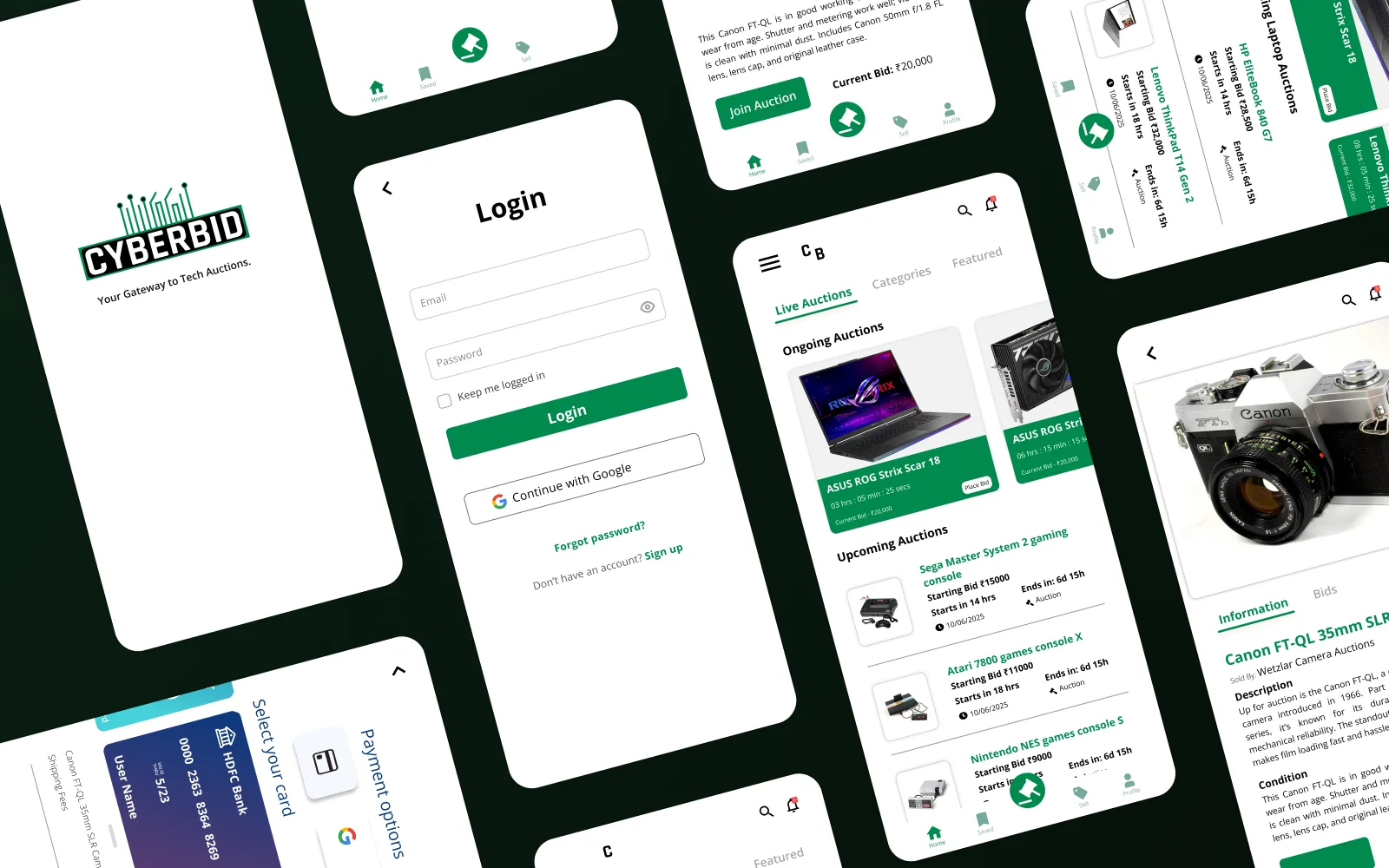
A mobile-first eAuction app that brings posting, bidding and awarding into one transparent flow for buyers and sellers.
- Discipline
- UI/UX Design
- Category
- Marketplace
- Role
- UI/UX Designer — end-to-end
- Tools
- Figma, User research, Prototyping
Overview
Picture a buyer at a growing company, tasked with sourcing laptops, desktops and accessories. The usual route is endless phone calls, scattered emails and bulky spreadsheets that make comparing slow and frustrating. Sellers have it no better: outdated systems, missed opportunities and a lack of transparency that takes the excitement out of competitive bidding.
CyberBid is a mobile eAuction app that puts the whole thing in one place. Sellers create an auction in a few taps, buyers bid in real time, and both sides see the same clear picture of what is happening.
It was my capstone project on a UI/UX bootcamp, and I owned the full cycle — from framing the problem space to validating a high-fidelity prototype with users.
// How I worked
- 01
Research
Surveys and interviews with Indian buyers and sellers, plus a review of where auction platforms are heading.
- 02
Define
Pain points, personas, journey maps and How Might We questions for both sides of the marketplace.
- 03
Structure
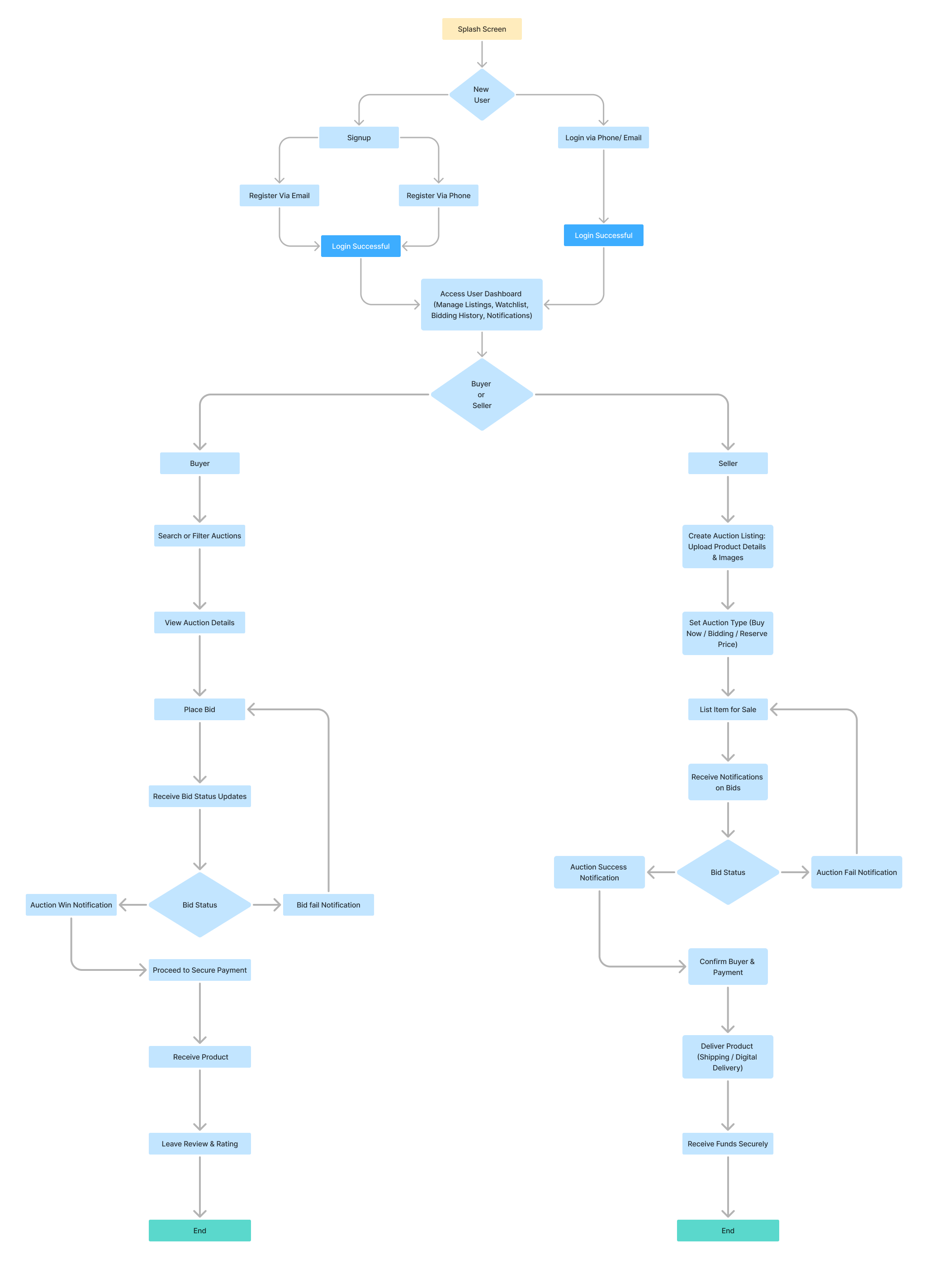
User flows for registration, buyers and sellers, and one information architecture to hold them.
- 04
Design and test
Low-fidelity wireframes built into high-fidelity Figma screens, then a clickable prototype tested with users.
Why online auctions
Buying and selling at auction is fragmented, slow and inefficient. Sellers rely on outdated methods to reach buyers, while buyers work across scattered platforms with no real-time view of what they are bidding on. I wanted to reimagine that space as a mobile-first platform that makes the process faster, fairer and more intuitive for both sides.
Two things became the spine of the project, and both came out of the research rather than my assumptions.
Transparency – Buyers and sellers both need a fair, real-time view of auctions, bids and outcomes.
An end-to-end experience – Instead of juggling emails, calls and separate tools, one place to post items, bid, track and award — less friction, more trust.
Who it is for
Sellers – Small businesses, retailers and individuals posting products or lots for auction.
Buyers – Professionals, businesses and individuals who want a quick, fair and engaging way to bid and purchase.
Both groups deal in collectible electronics, vintage tech and digital goods, are aged 18–60, and live in Tier 1 and Tier 2 Indian cities. They run into the same four obstacles: authenticity, unclear auction timelines, shipping risk and restrictive platform policies.
Research
Primary research – I ran surveys and interviews with buyers and sellers who use e-auction platforms across India, to find out what actually frustrates them, what they wish existed, and where the process breaks down day to day.
Secondary research – Alongside that, I looked at where Indian auction platforms are heading: real-time bid tracking, automated alerts and simpler interfaces to reduce friction; a growing demand for verified listings to cut fraud; and bulk listing and analytics tools becoming essential for smaller sellers.
The interviews confirmed most of my early hypotheses and reshaped the problem definition. Unverified listings, unclear bidding, missing seller reputation systems and poor shipping communication came up in almost every conversation.
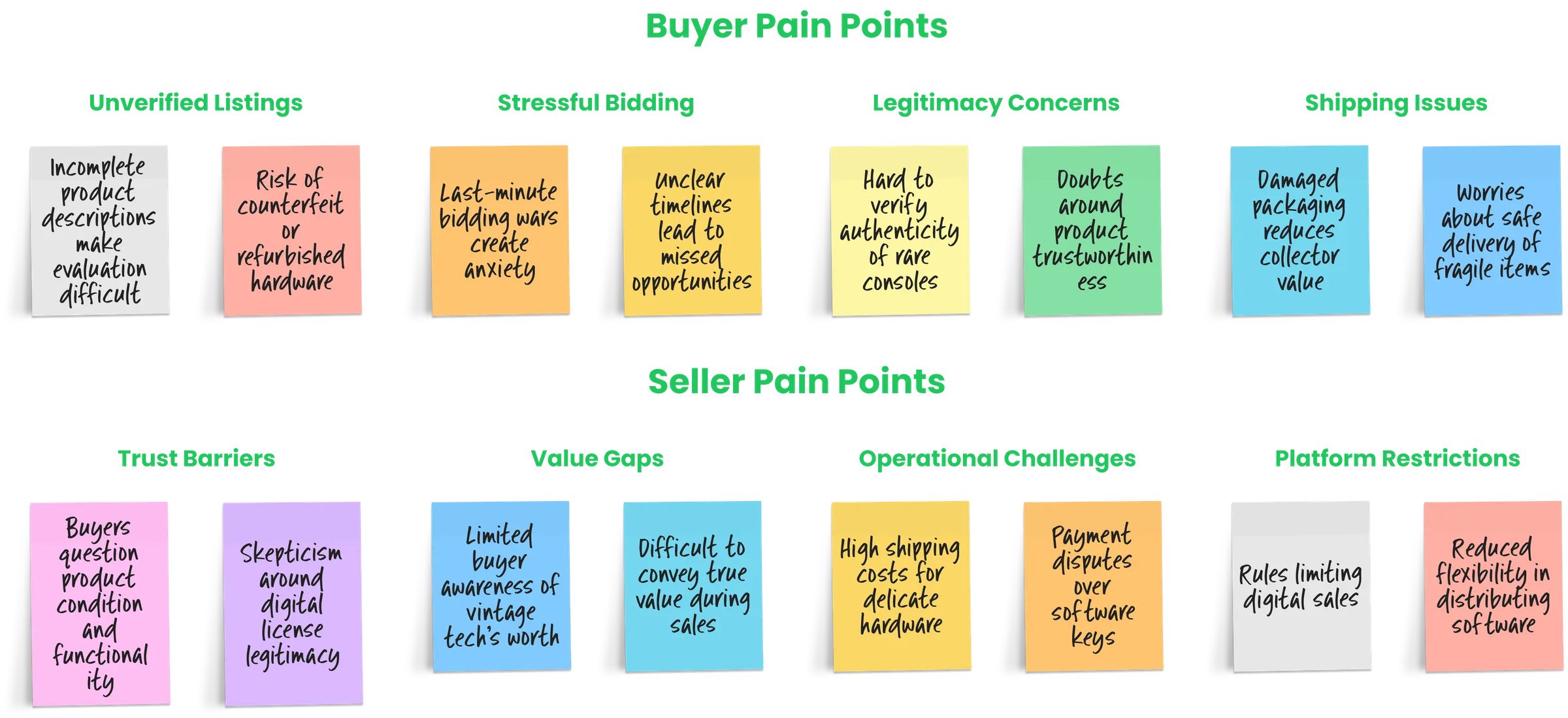
Buyer pain points
Unverified listings – Incomplete product descriptions make evaluation difficult, and there is a real risk of counterfeit or refurbished hardware.
Stressful bidding – Last-minute bidding wars create anxiety, and unclear timelines mean missed opportunities.
Legitimacy concerns – It is hard to verify that a rare console or collectible is what the listing claims.
Shipping issues – Damaged packaging destroys collector value, and fragile items make delivery a gamble.
// What buyers told me
- 68%
- hit incomplete listings or feared counterfeit hardware
- 59%
- felt anxious about last-minute bidding wars
- 54%
- could not verify that rare items were genuine
- 47%
- worried about damage in delivery
Seller pain points
Trust barriers – Buyers question product condition and functionality, and are sceptical about the legitimacy of digital licences.
Value gaps – Buyers often do not know what vintage tech is worth, so its true value is hard to convey during a sale.
Operational challenges – Shipping delicate hardware is expensive, and payment disputes over software keys are common.
Platform restrictions – Rules limiting digital sales reduce flexibility in how sellers list and distribute.
// What sellers told me
- 63%
- faced buyers questioning condition or legitimacy
- 52%
- said buyers did not know what vintage tech is worth
- 49%
- struggled with shipping costs or payment disputes
- 45%
- were limited by platform rules on digital sales
Where existing tools fall short
No personalisation – Listings and recommendations are generic, ignoring a buyer's interests, budget or collecting history. Nothing learns from past bids or saved searches.
Fragmented tools – Discovery, bidding, payment and shipping live in different apps and sites, which causes confusion and missed auctions.
Limited control – Sellers get little flexibility in listing formats or auction types — timed, reserve, buy-now. Buyers get little control over alerts and watchlists.
Cluttered interfaces – Information is inconsistent across platforms, so new or casual users struggle to follow a bidding flow or check that an item is genuine.
No end-to-end journey – Most platforms cover listing or bidding. Few carry a user from discovery through verification and payment to secure delivery.
Competitor analysis
eBay India – huge inventory across categories, a global reputation and established buyer protection. But the interface is complex, localisation for Indian users is thin, support is minimal and the bidding rules are unclear.
OLX Auctions – popular for second-hand goods, easy for local transactions, broad user base. But it has no formal auction features such as timed bidding, and listings often go unverified, which erodes trust.
Saffronart – specialist in art and antiques, with expert curation and authenticated listings. But it serves a niche audience and offers little in the way of bulk upload or wider seller support.
PowerBid India – localised for industrial and commercial auctions, strong at asset auctions and auction management. But it barely touches consumer goods and lacks real-time updates and intuitive seller tools.
Hypotheses going in
Verified listings and transparency – Clear descriptions, verified sellers and authenticity checks will cut buyer hesitation and build trust.
A streamlined bidding experience – Structured timelines, bid notifications and automated bidding will lower anxiety and reduce missed auctions.
Stronger trust mechanisms – Seller verification, escrow payments and authenticity guarantees will answer legitimacy concerns.
Reliable shipping – Secure packaging, insurance and live tracking will reassure both sides.
Value awareness tools – Market insights and benchmarks will help sellers show what an item is worth, and help buyers judge it.
Flexible platform policies – Safer digital sales and broader categories will bring more sellers in.
Personas and journeys
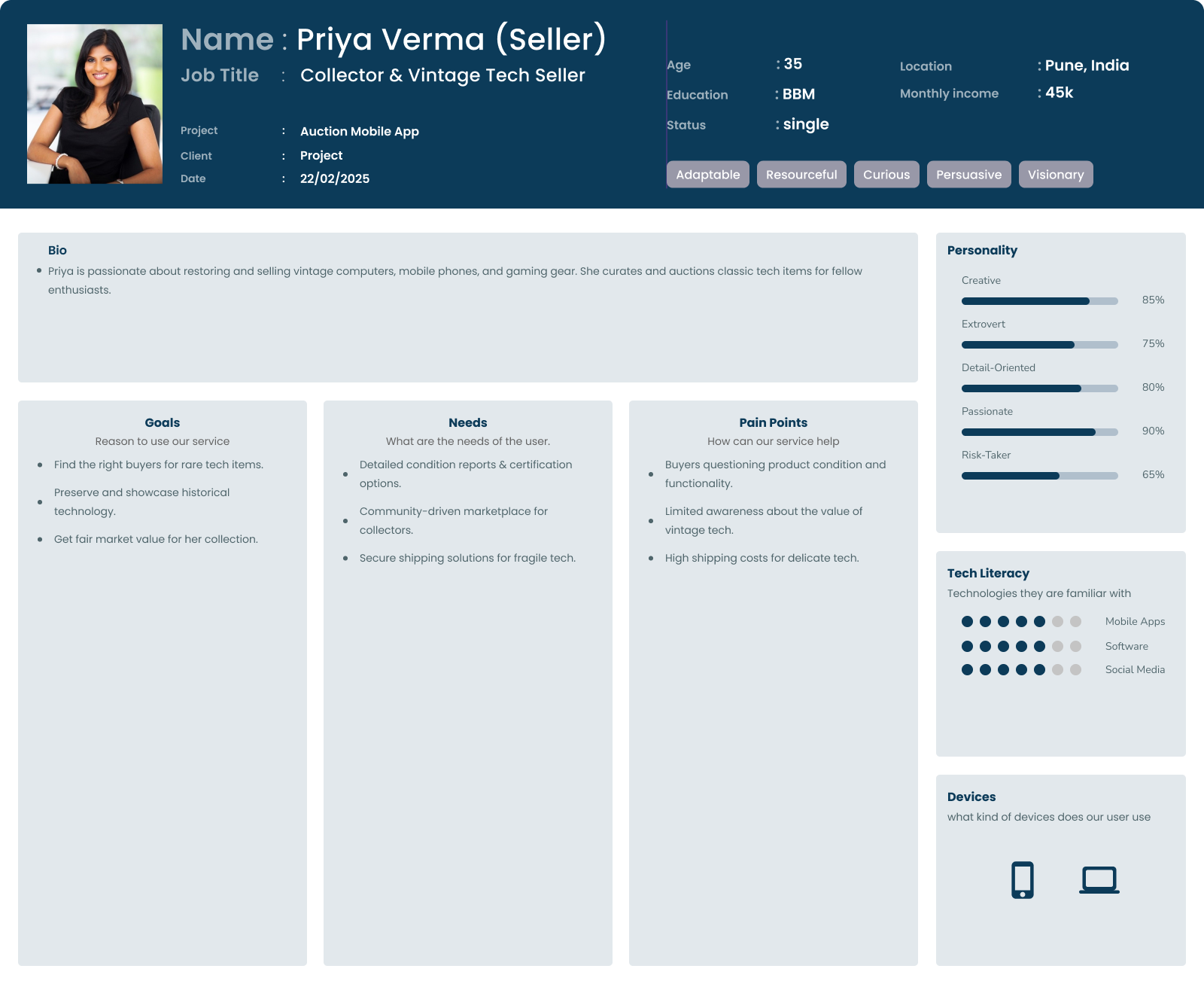
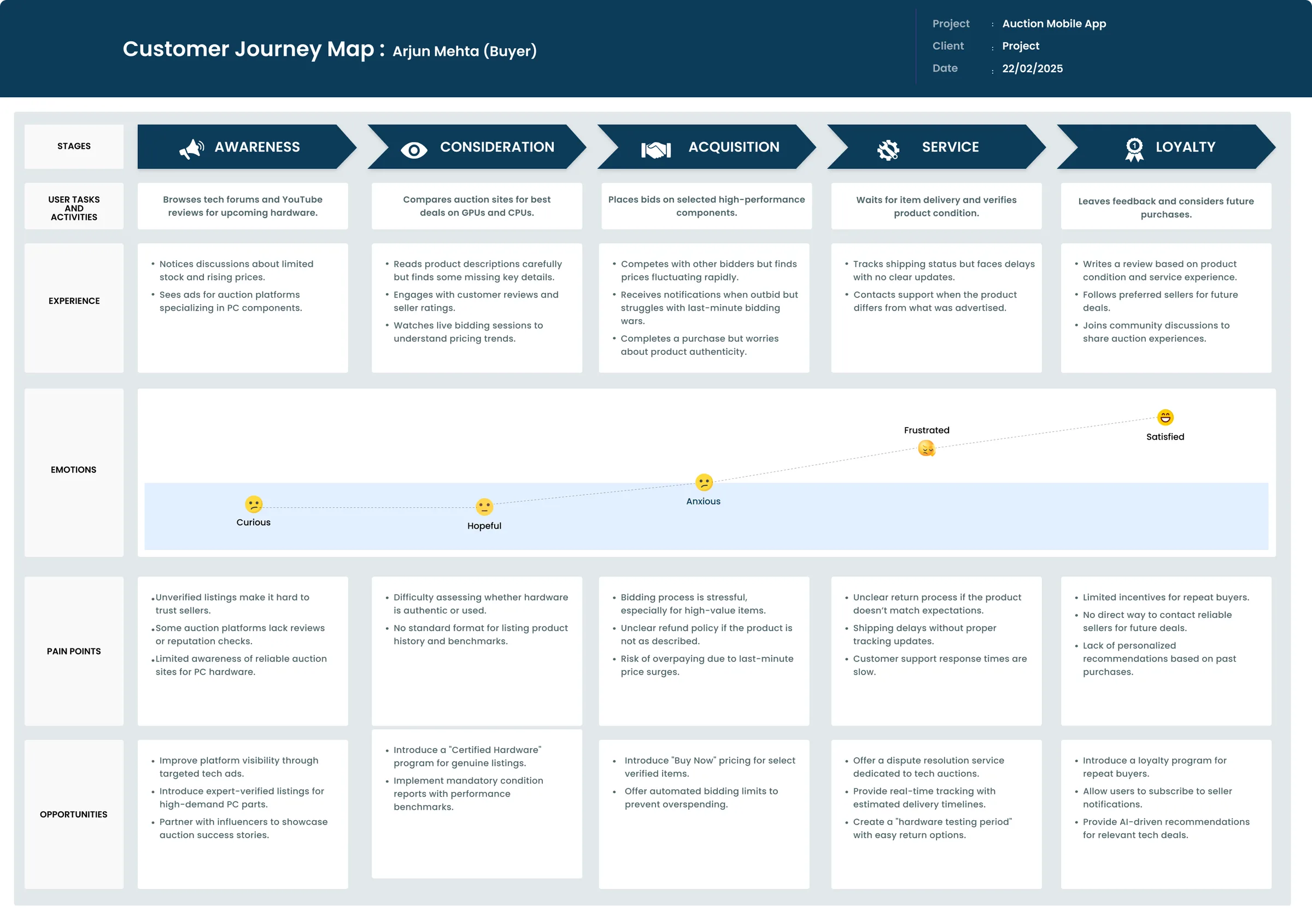
I turned the research into four personas covering both sides of the marketplace, then mapped their journeys to find where the experience breaks: the moment a buyer doubts a listing, and the moment a seller loses a sale to a question they cannot answer.

How might we
Each pain point became a question to design against.
Verified listings – How might we make sure every listing is verified, to build trust and prevent fraud?
Real-time bidding – How might we simplify bidding so buyers can place and track bids in real time without confusion?
Transparent validation – How might we validate sellers and products transparently, so buyers feel confident?
Shipping clarity – How might we give clear shipping information and a channel to the seller, so nothing is left uncertain?
Seller credibility – How might we help sellers build credibility through reputation systems and verified profiles?
Visibility – How might we give sellers analytics and promotional tools that make their auctions more visible and more successful?
Bulk listing – How might we streamline listing, including bulk uploads, so managing many auctions is easy?
Flexible templates – How might we offer flexible listing templates so sellers can represent products properly?
Flows and information architecture
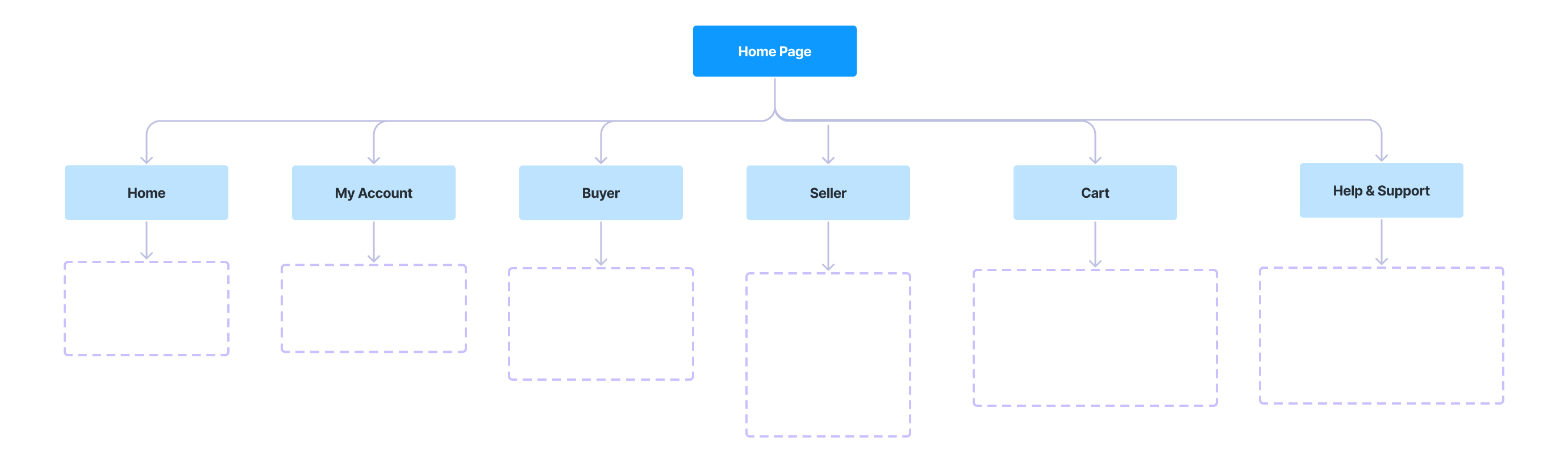
From there I mapped three flows — registration and home, the buyer path, and the seller path — and built the information architecture around them, so that posting, bidding, tracking and awarding all live in one structure instead of four.
Wireframes to high-fidelity UI
I started with digital low-fidelity wireframes, which let me iterate fast, make changes cheaply and keep the layout honest against the screen sizes people actually use in India.
Once the structure and flows held up, I built them out in Figma with the platform's colour, typography and iconography, so the result reads as one consistent product rather than a set of screens.


Prototype and testing
The screens were wired into a clickable prototype and put in front of users, so the flows were tested as a journey rather than judged as static screens.
What's next
Smarter recommendations – Suggestions driven by bidding history, preferences and past purchases.
Live bid tracking – Real-time alerts for price changes and competing bids.
Verification badges – Visible badges for verified sellers and products.
Wider seller tools – Bulk upload, analytics dashboards and promotion.
Offline mode – Manage auctions and track bids on the move.
What I learned
Research changed what I built. My instinct was that the bidding screen was the heart of the product; the interviews showed that trust decides whether a bid ever happens, so verification and seller reputation moved to the centre of the design.
Designing for two audiences at once also meant every decision had two readings. A change that makes a listing faster to post can make it harder for a buyer to judge, and holding both sides in view was the hardest and most useful part of the project.
Like what you see?
Let's talk about the role or project — I reply within 24 hours.